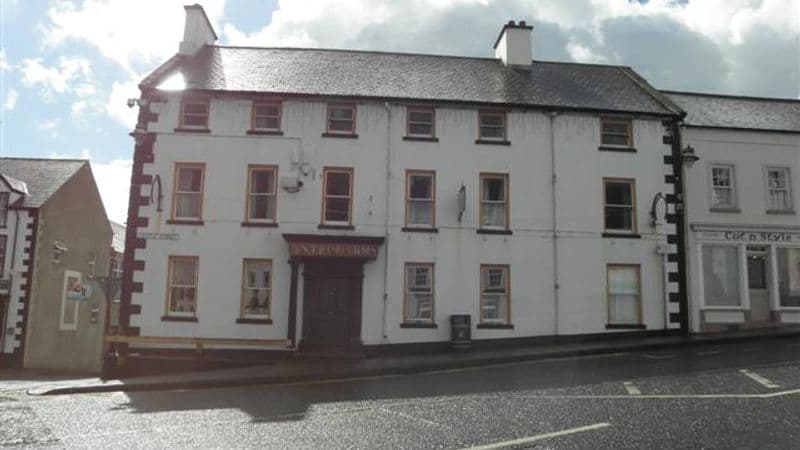

Photo: Kenneth Allen, via geograph.org.uk, licensed CC BY-SA 2.0.
A major fire tore through the derelict Antrim Arms in Ballycastle, County Antrim, on the evening of Sunday 19 April 2026, drawing 42 firefighters from four stations and reopening a long-running debate about how the UK protects its vacant listed buildings. The Police Service of Northern Ireland is treating the blaze as arson, the latest in a pattern of deliberate fires at derelict heritage sites across the country.
What happened on Castle Street
The Northern Ireland Fire and Rescue Service received its first call at 8:08pm on Sunday evening, with flames already visible from the three-storey former hotel at 75 Castle Street, on the corner of The Diamond in the centre of Ballycastle. According to loveBallymena, crews from Ballycastle, Ballymoney and Portrush stations attended, supported by aerial appliances from Northland and Springfield and a command support unit from Kilrea. Streets around The Diamond and Castle Street were closed during the operation, and residents were asked to keep windows and doors shut while smoke hung over the seaside town.
Video and eyewitness reports carried by Sky News and BBC News showed flames breaking through the roof and the upper floors. NIFRS confirmed that crews focused on containing the fire within the building footprint and protecting neighbouring properties on the tightly packed historic streetscape. The roads reopened the following morning.
Police treating the fire as deliberate
Need fire safety work done?
Browse our directory of qualified, vetted fire safety professionals across the UK
Browse Directory →The PSNI has confirmed it is investigating the fire as arson. A statement reported by RTÉ said officers were "investigating the circumstances surrounding a fire at a property in Castle Street, Ballycastle, on Sunday" and appealed for anyone with information to come forward. The Irish News reports that the PSNI is working with NIFRS fire investigators and that the cause is being treated as deliberate ignition rather than accidental.
A listed landmark with a troubled recent history
The Antrim Arms is a Grade B1 listed former coaching inn that had traded as a hotel and pub for generations before falling vacant. The Hearth Historic Buildings Trust records the building as one of the defining elevations of The Diamond, and it appears on the Department for Communities' Heritage at Risk Northern Ireland (HARNI) register of vacant and underused listed buildings. Causeway Coast and Glens Borough Council had placed cordons around the structure more than a year before the fire on the basis of concerns about its structural integrity.
The owner, Maplemanor Properties, submitted a Listed Building Consent application in 2025 arguing that the structure had become "a dangerous structure" and sought permission to demolish. That application was refused by the council in August 2025 after consultation with the Department for Communities' Historic Environment Division, and no appeal was filed. Sinn Féin councillor Cara McShane told RTÉ after the fire that the building was "a cornerstone of heritage in the town", echoing wider concern that contested demolition cases can leave listed buildings in prolonged legal and physical limbo.
The wider picture: heritage at risk
The Antrim Arms fire lands in a climate where derelict heritage is already under pressure. Ulster Architectural Heritage's Heritage at Risk Review 2023/24 recorded 96 new additions to the HARNI register in a single year, with a running total of 344 buildings saved since 1993. Vacancy itself is one of the strongest predictors of catastrophic fire loss: a building without occupants has no one to detect ignition early, no maintained alarms, and often no live utilities to support a sprinkler system.
Similar incidents have punctuated the last two years. INFIRISK has previously covered the fires at Woodend Hospital in Aberdeen and a derelict building in the UK where arson was suspected, each showing the same pattern: a listed or locally important building, long vacant, with incomplete passive fire protection and no active suppression, catching fire after hours and suffering near-total loss before crews could intervene.
Expert insights and guidance from the INFIRISK editorial team, covering fire safety regulations, industry standards, and best practices.
Why historic buildings burn differently
Fire safety professionals working with heritage stock know that these buildings behave very differently from modern construction. Concealed voids behind lath-and-plaster ceilings can channel fire vertically through three or four storeys before it shows at roof level. Original timber floor structures, dry after decades without heating, ignite readily. Compartmentation is often incomplete because interior walls have been opened up during successive refurbishments, and what remains may no longer meet a 30 or 60 minute standard.
Guidance from Historic England and the London Fire Brigade stresses that these characteristics are manageable, but only with a tailored fire strategy. Our own earlier case study on retrofitting fire safety systems in a Grade II listed building walked through how a multi-disciplinary team balanced heritage constraints against compliance, using concealed detection, mist suppression and upgraded fire doors with matched timber veneers. None of that is possible in a vacant, unsecured building left to deteriorate.
Practical takeaways for fire safety professionals
Treat vacancy as a risk multiplier. A fire risk assessment for an occupied listed building is not adequate for the same building once it falls vacant; a revised FRA should cover trespass, arson, unmaintained services and loss of active systems.
Engage the Historic Environment Division early. Where demolition or major intervention is on the table, sustained engagement with statutory consultees prevents the stalled-consent cycle that leaves buildings in limbo.
Specify interim protection for dormant assets. Secure boarding, perimeter fencing, CCTV with remote monitoring, and a watching brief from the local fire service reduce arson opportunity until a long-term scheme is in place.
Plan for the void spaces. Pre-incident plans shared with the local fire service should map concealed voids, structural weaknesses and any partially-retained compartmentation so crews are not fighting the building as well as the fire.
Budget realistically for heritage compliance. As the Maplemanor case illustrated, preserving a single gable wall was estimated at over £1 million; realistic early costings reduce the temptation to run a building down until demolition looks inevitable.
What to watch next
Attention now moves to the PSNI investigation, the structural assessment of what remains of the Antrim Arms, and the council's decision on whether the damaged fabric can still support a listed-building-led regeneration or whether the case for demolition has fundamentally changed. For the wider sector, the fire is another data point in a difficult argument about who pays to keep vacant listed buildings safe, and how quickly the system can move when a heritage asset shows clear signs of decline.
Sources
Need fire safety work done?
Post your requirement on Infirisk and receive competitive proposals from qualified, vetted fire safety professionals across the UK

INFIRISK Editorial
INFIRISK Team
Expert insights and guidance from the INFIRISK editorial team, covering fire safety regulations, industry standards, and best practices.
32 articles published
IT
More from INFIRISK Team